
Post fire forest regeneration and why carbon credits are bull
Carbon credits are bull; invasive weed suppression might be better than planting trees.

Before starting on this weeks Green Dispatch topic, I’d like to announce that I’ve added a perk for paid subscribers, a weekly roundup of ecological and sustainability news. Paid subscribers can find the benefit here: Green Dispatch Perks. I hope you enjoy!
Over the last month, I’ve been lucky enough to hike Cuyamaca Peak a couple of times. At 6,500 feet, it is the second highest mountain in San Diego County. The summit offers astounding views, from the Pacific Ocean to the eastern extant of the Colorado Desert. Here is the view, facing west and panning from north to south.
The mountain is part of the Peninsular Range that stretches from Baja California, Mexico, to Los Angeles. Cuyamaca Peak itself is in the southernmost region of the Cleveland National Forest and is part of the 26,000 acres of the Cuyamaca Rancho State Park.
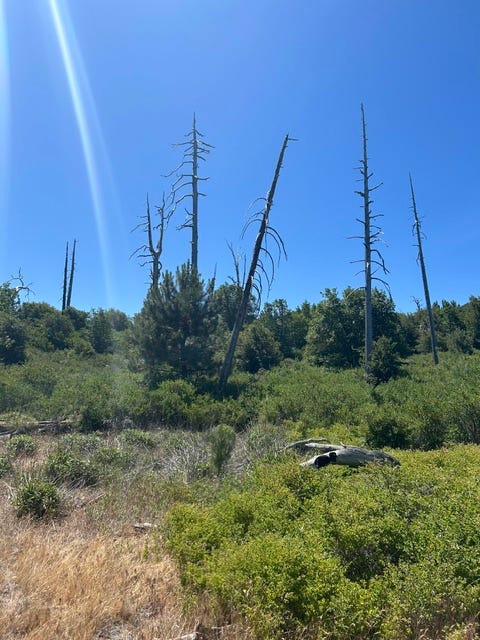
This region burned in the 2003 Cedar Fire, with 98 percent of the pine forest consumed. The fire transformed the forest lands into moonscapes, blackened earth with stands of dead, charred trees and stumps.
Regeneration
Within weeks of the Cedar Fire, shrubbery sprouts appeared. My wife and I hiked through some of these areas, the ground covered with knee-high greenery. When we returned about a year or so later, the shrubs had grown to about eight or nine feet, almost a complete monoculture of Palmer lilac (Ceanothus palmeri). Pines were returning, too—a few here, a few there.
Reforestation project begins
In 2007, the California State Parks department began a reforestation project. The project’s plans included planting pines on 2,530 formerly forested acres, with the expectation that the conifers growing in these patches will spread their seeds to adjacent areas and reestablish the forest as it was before. As of 2013, 1,200 acres had been planted with 350,000 conifer seedlings.
Monies for the project came from carbon offset financing. Carbon offsets are bought by individuals or companies from organizations that plant trees or perform other activities that are thought to remove CO2 from the atmosphere. These environmental “Get Out of Jail Free” cards enable companies to portray themselves as “green” or let them avoid costly anti-pollution measures.

One of the big companies attempting to offset its carbon output with this reforestation project is Disney. They even made a video touting their efforts in Cuyamaca.
Hmmm… it doesn’t add up
First, if storing carbon is your goal, the naturally occurring chaparral that grew up among the forest’s ashes has been recognized for at least 20 years as an important sequester of carbon. Second, if turning the park back into acres and acres of forest is your goal, scientists found pines were already sprouting among the shrubbery within five years of the fire, mostly Coulter pines, with patches of Jeffrey pines. And there may have been more pines than the researchers found. In their published paper the researchers note, “[T]he lack of observed regeneration in dense shrub cover may have been the result of our failure to detect it due to impaired visibility.”
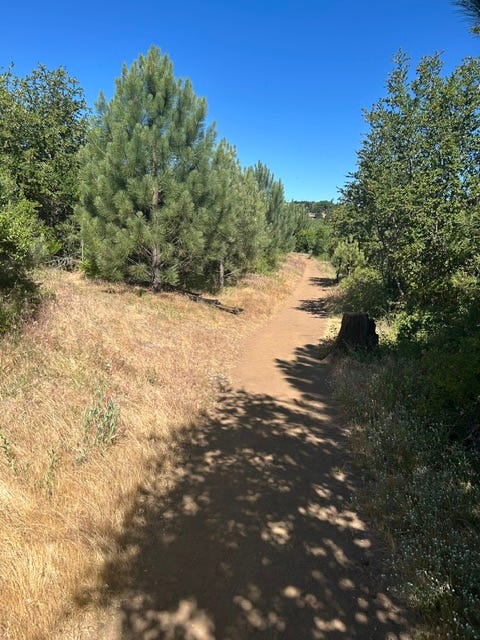
The trees were coming back to the park, even without conservation crews planting seedlings. But you wouldn’t know that from the marketing material coming from the carbon credits folks. The way they discuss the reforestation project, they would have you believe the trees would not come back without their efforts.
To further back up their rationale for the planting, the fire was depicted as an aberration, something that would not have occurred without human meddling. In this case, the meddling is previous fire suppression, which allowed for excessive growth of trees and greater buildup of dead branches on the forest floor. The increased “fuel” led to more intense flames that completely consumed the forest.
(Back in 2003, the forests were also suffering from years and years of punishing drought. I remember driving through the area in the early 2000s and thinking that it was possibly the last time I would see the forest as it was and that a big fire would come through soon. The drought, which was associated with climate change, isn’t brought up much when discussing this fire.)
History negates the rational of correcting an aberration. The Santiago Canyon Fire turned much of Southern California to ashes in 1889, including Cuyamaca Peak and the surrounding area. Back then, after the fire, chaparral replaced the forest, and natural forest succession led to the chaparral plant community being naturally replaced by the pines. That’s why most of the trees burned in the Cedar Fire dated back to the 1890s.
Also, the planting process, getting those conifer saplings in the ground, is more than just digging a few holes and plopping in the young trees. In this project, the reforestation crews use large masticators to mow down the chaparral, disturbing the soil and giving opportunities for nonnative grasses and annuals to invade.
Follow the science, not the money
I can’t predict how this reforestation project will turn out. For all I know, it will recreate in 150 years or so, a forest that very much resembles the one that had been in the Cuyamaca State Park in 2002. Our great-great-grandchildren may enjoy the pines as we once did decades before.
But my best guess is that the project is misguided, driven not by science, but by big money. If a proper reforestation effort were to commence, there would have been more reliance on an understanding of history, science, and field observation. If anything, the reforestation project certainly jumped the gun. And if you’re getting carbon credits for planting trees, and the trees are coming back anyway, the credits are worthless.
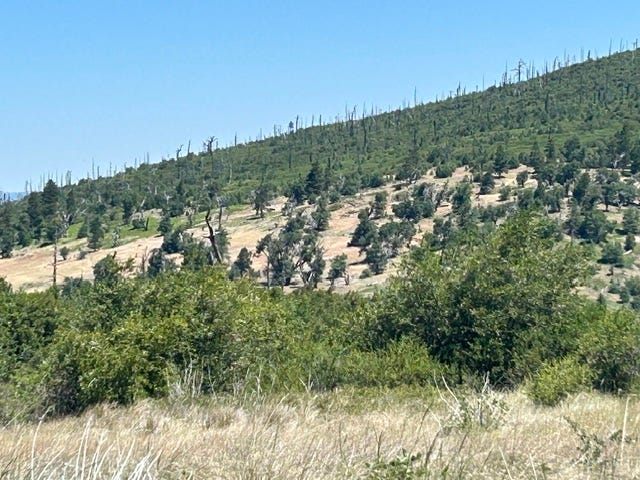
Research conducted after the fire found that the percentage of invasives increased from three to 40 percent in the area. Reforestation monies and efforts would be better spent fighting these invasives. Whatever the natural landscape, chaparral or forest, it will store more carbon than the grasses. Invasives also greatly disrupt natural ecosystems, sometimes fully excluding them.
There are a lot of folks, smart, well-educated ecologists and conservationists who support the reforestation of Cuyamaca. What do you think? Is reforestation a good idea? A fools errand? Will it disrupt natural succession? Please leave your thoughts by clicking the “Leave a comment” button.
Additional photos from hikes on Cuyamaca Peak:


I think I still have a box of information we got ca. 2010 from the park via the Records Act. I recall that the survey data for tree survivorship was problematic, and it looked like they were using seedlings that they were supposed to plant in new areas to replant seedlings that had died. If you want to dive into the old data, I can see if I can find it for you.
This brings to mind the famous Eric Hoffer quote: "Every great cause begins as a movement, becomes a business, and eventually degenerates into a racket."