
Light pollution: nighttime is getting brighter the world over
Recent findings, however, give reasons for hope

The summer when I was four, my family and I lived in Atlanta. I remember it was hot and humid, and that’s where I learned how to swim. We ate at some nice barbecue places, but one day, the big news was there was a new restaurant in town, one that had people across the country excited. They just served hamburgers, French fries, and soda. It was called McDonald’s.
We went one night to try the super-affordable, super-fast food. I don’t remember anything about what I ate that night. What I do remember were the bright yellow arches, the glowing neon that emanated from the shiny new building, and the tall poles with their big lights beaming down on the parking lot. My parents and other families were probably happy they could feed themselves and their kids for a couple bucks. What I remember most from that night is that McDonald’s was ILLUMINATED!
McDonald’s no longer features glowing arches, but as much as humans like fast food, we like to light things up at night. And just like that McDonald’s on that long-ago Atlanta night, we light things up a lot. We light our suburban streets and front porches. We illuminate freeways and parking lots. All these lights help us get around after dark, and we feel safer when we turn on the lights. But these photons can spill over into the surrounding countryside and hillsides. This unwanted light is called light pollution.
Light pollution history
The first mention of light pollution I found was in a search of The New York Times historical database: an article on astronomers struggling with the increasing lights of Tucson in the early seventies.1 With advances in air conditioning enabling residents to live through the extreme heat of southern Arizona summers, the population of Tucson had mushroomed from 30,000 to 300,000. Federal housing policies also encouraged ownership of single-family homes, leading to urban sprawl. The bright lights of the big city were spreading to the countryside, in this case the Sonoran Desert.
The resulting bright lights made research difficult for the astronomers at several nearby observatories, including the University of Arizona’s Steward Observatory and the Smithsonian’s Whipple Observatory on Mt. Hopkins, 47 miles south of Tucson in the Santa Rita mountains.
Light pollution is often overlooked. Unlike other forms of pollution, it’s only around half the time, from dusk till dawn. And it’s not considered pollution by most folks. We’re attracted to the bright lights of our cities. For years and years after the astronomers in southern Arizona first complained of the bright lights of Tucson, light pollution was thought to affect only astronomers and star gazers.
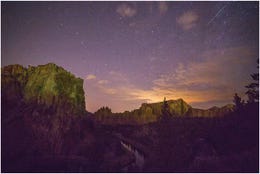
More recent research has revealed that light pollution has broader ramifications, affecting animals and ecosystems.
What we now know
Even some of the darkest skies are being encroached by light pollution. Chili’s Atacama Desert has been prized by astronomers for its almost crystal-clear night sky and lack of clouds, averaging more than 300 clear nights per year. Astronomers there just fought—and won—a battle to keep an energy firm from developing a green-power project, yet concerns persist that they are fighting a losing battle.
The astronomers are aware that the forces of greater populations and commerce are not on their side. Nighttime is getting brighter the world over. Though researchers recently found that certain light pollution policies have brought about some dimming, notably in Europe, daily satellite data has shown that light pollution has worsened by 16 percent worldwide in the last eight years. Most of the lighting increased in Africa and Asia. The United States remains the brightest country; we have by far the highest total luminosity in the world, with China, India, Canada, and Brazil following. This study was published in the journal Nature in April.
One of the factors spreading lights into rural areas and the countryside is the proliferation of data centers. The National Wildlife Federation lists light pollution as one of the banes of the spread of data centers. Of the many complaints of Meta’s Stanton Springs data center in Georgia is the bright lights that illuminate the nearby forests and neighborhoods.
It’s more than astronomy
Plants
The effects of night lights on plants have been known to botanists for a long time. Back in 1936, scientists found that plants growing around night lights experienced changes in their physiology, affecting leaf development and the timing of when these plants dropped their leaves in fall.
Photosynthesis is a complex process, which plants complete in two phases, a daytime, sunlit phase, and a nighttime, dark phase. A study published in February of this year found that night light affects the dark phase of photosynthesis. With this part of the cycle disrupted, plants have a difficult time synthesizing the sugars on which they depend (and all other life depends on as well).
Insects
Just about anybody over the age of fifty will tell you that there were a lot more insects around a generation or so ago. Culprits in the decline include increased urbanization and the use of pesticides. Our night lights also play a part.
Fireflies use their bioluminescence to find their mates; nighttime lighting can confuse them. Mayflies can be confused by street lighting, which makes asphalt appear to be bodies of water. The befuddled flies lay their eggs on roads instead of in streams or lakes, which is extremely detrimental to these insects that live and breed for a single day.
In 2021, scientists found that street lighting diminished the number of moths and caterpillars compared to unlit places (47% reduction in hedgerows and 33% reduction in grass margins). Night lights also disrupted feeding behaviors of nocturnal caterpillars. LEDs are a climate change solution, as they save a lot energy, but this study found that streetlights using LEDs affect insects more than conventional sodium lamps.
Mammals
Lights have been found to disrupt circadian rhythms, alter predators’ foraging, and movements. Nocturnal mammals will avoid illuminated areas. This can keep them away from underpasses created for them to pass beneath freeways or cross other areas. The researchers involved in this study found, however, that badgers and other animals quickly resumed using underpasses after lighting was reduced or removed.
Lights can delay the emergence of bats from their roosts at dusk, when the insects they feed on are most abundant. Many species of bats avoid illuminated areas, as they expose the bats to predators. Some bats never leave their roosts because nighttime lighting can fool them into thinking it’s daytime all the time. In such cases, the bats may remain roosted and die of starvation.

Birds
Large cities with their lights are known to disrupt the migration of birds. To stay cool and save energy, many birds migrate at night. Normally guided by moonlight and starlight, stable markers in the night sky, bright, artificial lights can confuse birds. In New York City alone, an estimated quarter million migratory birds get confused, crash into buildings and windows, and die every year. The spread of lights through our highways and suburbs further complicates bird migration.
Good news
There are some hopeful developments for keeping the nighttime dark. Some municipalities are working at dimming their lights. Louisville, Kentucky, is taking noteworthy strides to help migratory birds and otherwise keep the night a little darker. The city’s mayor, Craig Greenberg, is spearheading a policy initiative to reduce unnecessary lighting, from 11 p.m. to 6 a.m., during peak bird migration months, April and May in the spring, and September and October in the fall, as well as promoting a voluntary Lights Out Pledge for citizens and businesses.
The same team of scientists who found the world was getting 16 percent brighter found encouraging news as well. Due to municipal policies, such as installing streetlights that glow with a reddish hue, Europe now has dimmer nights. France in particular has seen a drop of 33 percent in nighttime illumination.
Are you aware of light pollution? Is your municipality doing anything to reduce nighttime lighting? Are you reducing the lights around your home? Please share your thoughts by clicking the “Leave a comment” button.
Previous Green Dispatches on pollution:
By JAMES C. CORNELL Jr. . 1971., Jun 20 “Light Pollution from a Growing Tucson Threatens ‘Astronomy Capital of the World’: Light Pollution Threatens ‘Astronomy Capital’.” New York Times (1923-), 2. https://www.proquest.com/newspapers/light-pollution-growing-tucson-threatens/docview/119266259/se-2.
So important. I’d like to add how it affects humans. Messing with circadian rhythms and our electromagnetic cloud. Migraines, less sleep quality and ability to dream. The low amber lights of the past were more synced to how we evolved with the warm glow of fire. Now with the bright white led it hijacks the brain to be on all the time . As well as taking away the wonder. The magic of sitting under the stars and moonlight and being able to see a shooting star.
Personally, in my rural community in the Poconos, I feel that light pollution is nearly as bad as noise pollution. I lived on Long Island, NY, most of my life. It was so bright, not to mention noisy, at night that it was one of the factors of my leaving. I moved to a rural area believing it would be less bright and less noisy. My private, un-gated community is in a vacation area and half of the homes are vacation or second homes. Many residents appear to be afraid of the dark. Their homes are lit up whether they're here or not. Most have flood lights on every side of the house. Many of those flood lights are motion activated. Most of the homes also have huge strings of what I call circus lights, much brighter than Christmas lights, and those get turned on every night around dusk and stay on till midnight whether the folks are outside or not. I have shades or blinds and blackout curtains on every window in my house. Every evening at dusk I go through the same ritual of closing the shades and curtains before the flood and circus lights start blazing. Luckily, I don't live near any large towns or industrial areas, so I don't have that issue.
I wish people were more considerate, but alas the worst is yet to come...